

Making Waves: University of Manitoba’s electromagnetic imaging lab is developing a machine that could help improve treatment for stroke patients
Profile written by: Brian Cole
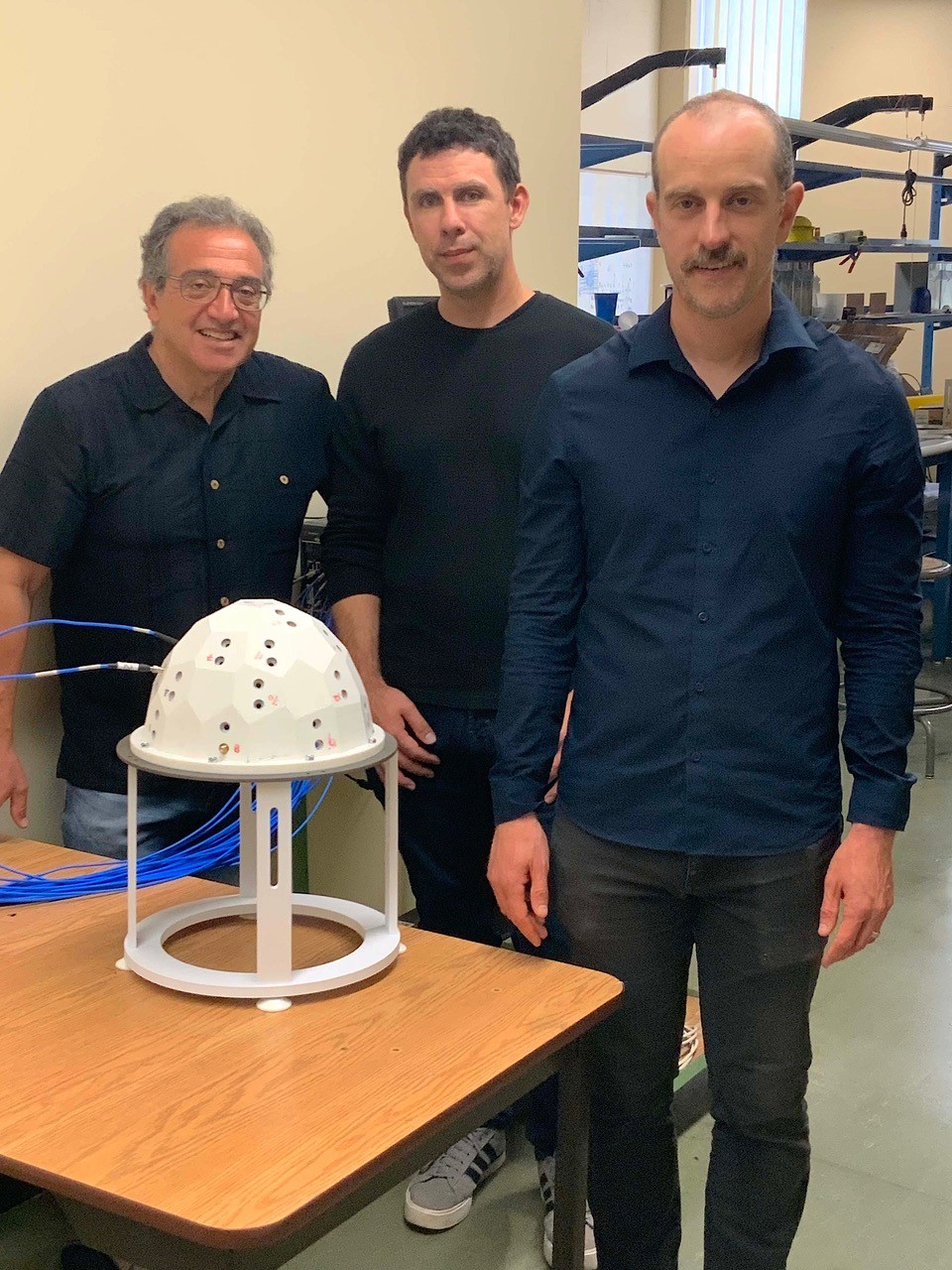
From left: Joe LoVetri, Ian Jeffrey and Colin Gilmore with a prototype of a helmet-like device that uses electromagnetic waves to create images of any object placed inside the casing. The blue wires connected to the device are power antennas that can transmit and receive electromagnetic energy inside the casing. The signals are used to create a computerized image of any object inside the casing.
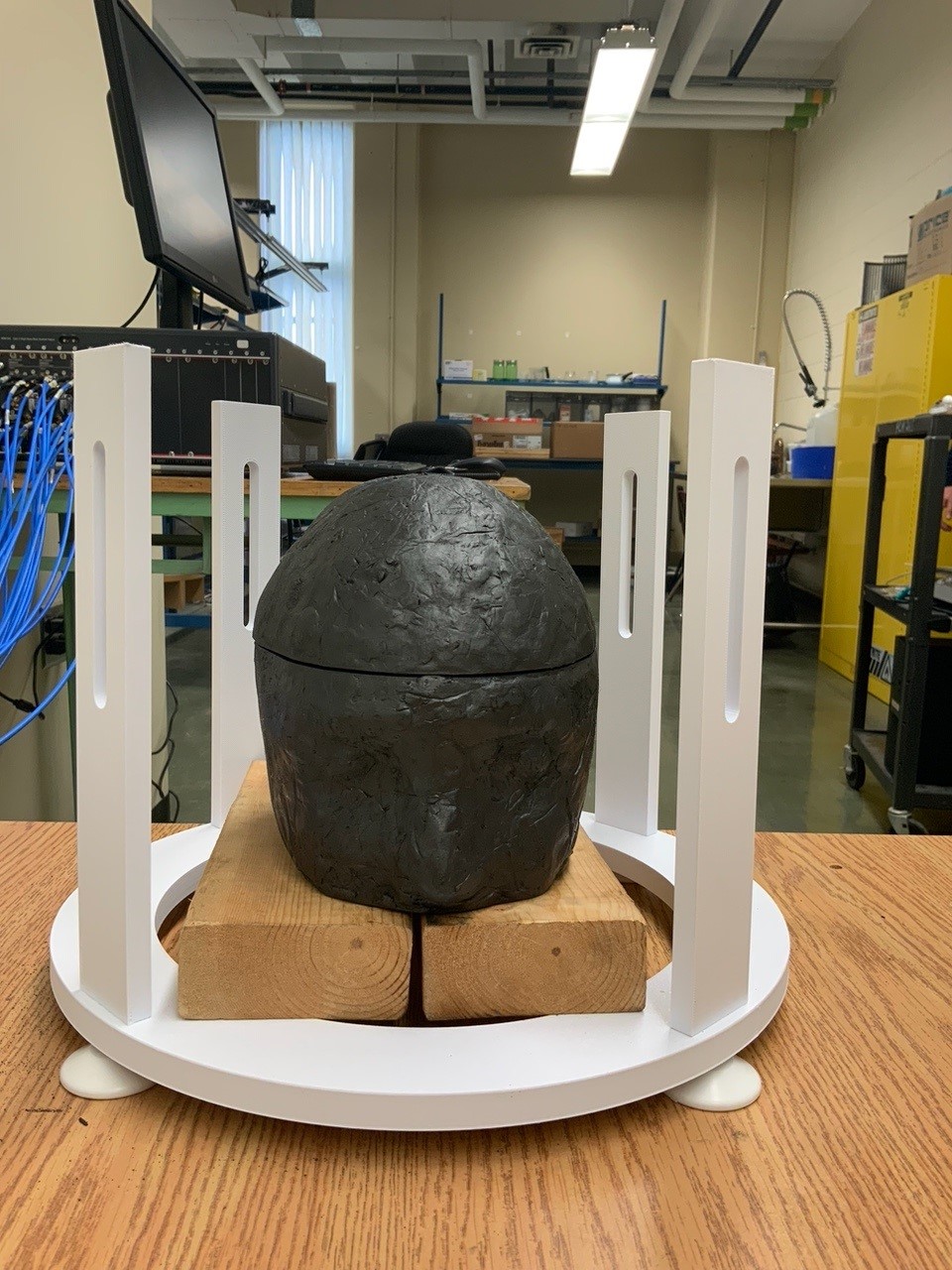
A head on look at the model head used by the EIL team.
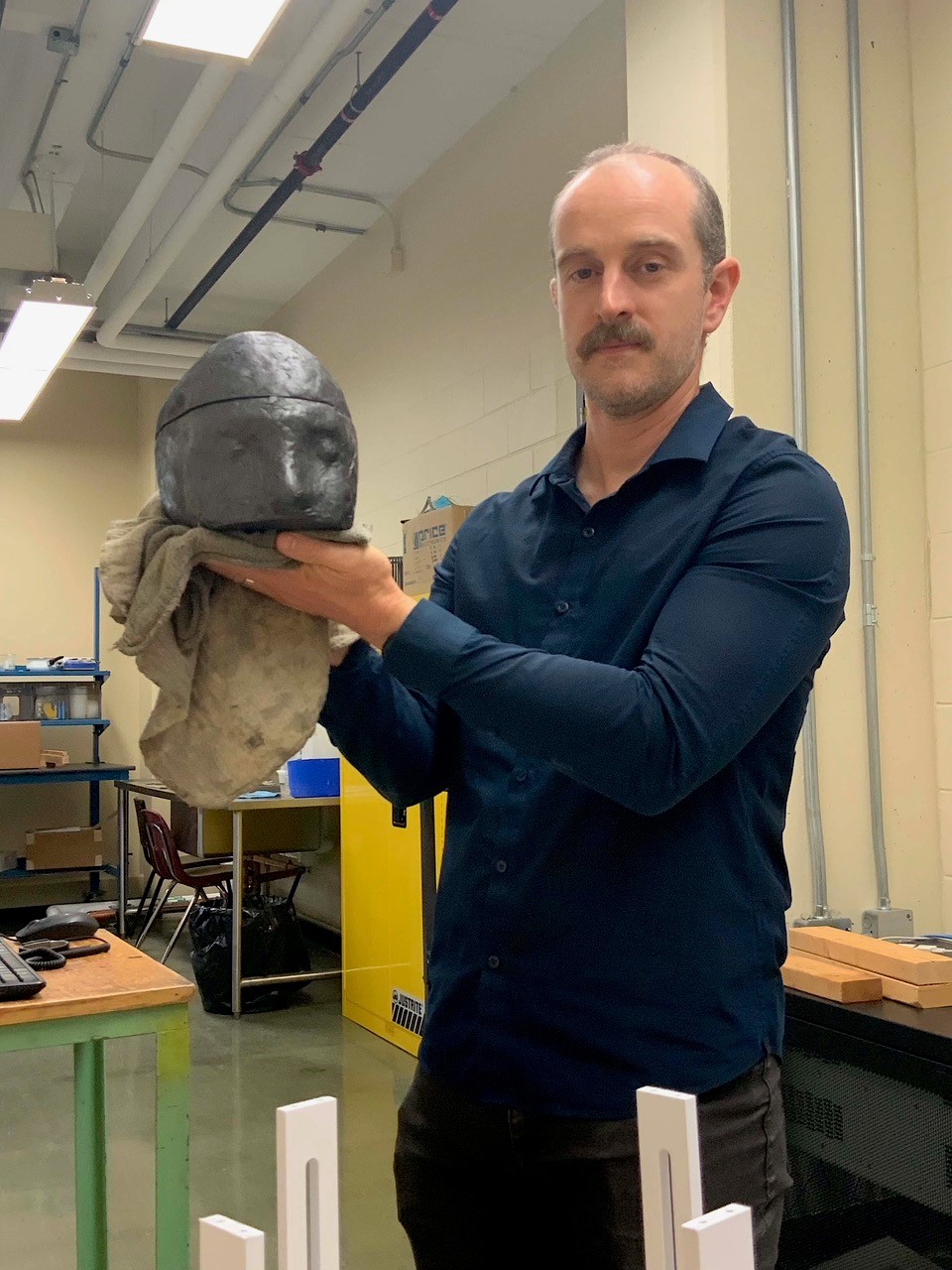
Colin Gilmore with a model of a human head specially created by EIL team collaborator Matteo Savazzi while he was a post-doc with Francesca Vipiana’s team at Politecnico di Torino in Italy. The model has been designed to reflect electromagnetic waves in much the same way a human head would
Could electromagnetic waves similar to those transmitted and received by your cellphone one day be harnessed to create images that would help detect and classify a stroke in real time?
The answer to that question is yes, according to Ian Jeffrey, a professor in the Department of Electrical and Computer Engineering at the University of Manitoba.
In fact, Jeffrey and his colleagues, professor Joe LoVetri, associate professor Colin Gilmore, and assistant professor Vahab Khoshdel, are working to make it happen sooner rather than later.
All four are members of the university’s Electromagnetic Imaging Lab (EIL), which was first launched in 2010. As the name suggests, the lab focuses on researching potential uses for electromagnetic waves, an umbrella term used to describe different forms of electromagnetic energy that move through space at various frequencies.
Electromagnetic wave theory, and its application to real-world problems, has been an area of research for over 150 years. In addition to household applications like cellphones and microwave ovens, electromagnetic waves have been used for exploration and non-invasive detection for decades, including in subterranean exploration by the oil and gas industry.
More recently, scientists around the world have been looking at new ways to harness the power of electromagnetic waves, often in the microwave frequency range, to create images that could be used to solve problems in areas as diverse as agriculture and medicine.
“One of the most interesting things about (EIL) from a university perspective is that we’re not just working on the core science (of electromagnetic imaging),” says Jeffrey. “We do work on the core science, but we’re actually very much… application-driven”, he says.
The stroke project is a case in point.
Typically, strokes are diagnosed using a computed tomography (CT) scan, which is produced using a series of X-rays, or a magnetic resonance imaging (MRI) machine, which uses a strong magnetic field and radio waves to produce images.
“MRI and CT are standards of care for the detection and assessment of stroke, but are not ideal when attempting early classification of stroke during emergency transit or when assessing post-stroke recovery through regular follow-up imaging,” Jeffrey says in a summary of the project.
For example, because CT scans use X-rays, they can pose potential health risks to patients who are frequently exposed to radiation. MRI machines, meanwhile, are large, stationary and relatively expensive to operate.
The lab’s goal is to build a device that will be smaller, less expensive and safer, says Jeffrey, noting that other research groups around the world are pursuing the same objective.
“We propose to develop a microwave imaging (MWI) system for detecting and classifying stroke in real time,” Jeffrey says in a summary of the project, noting that such a system would “provide a practical means of early stroke classification that is deployable in emergency vehicles and can be safely used for continuous recovery monitoring.
Jeffrey says the device, which is expected to end up looking something like a desktop computer connected to a helmet, will work by transmitting electromagnetic waves towards a patient’s head. Receivers will measure how those waves are reflected or scattered. The data will then be uploaded into a computer which will use an algorithm, developed by EIL members and graduate students building on the many contributions of past graduate students, to create an image.
“The idea is that it’s an imaging modality that offsets the cons of (CT scanners and MRI machines). So, it is extremely cheap… and it’s safe to use,” he says, noting that the device will emit no more energy than a cellphone.
But the true value of the proposed device may be its portability and effectiveness in identifying the type of stroke a patient may be having.
There are two types of stroke, ischemic and hemorrhagic. The former occurs when blood flow in the brain is interrupted by a clot. The latter occurs when a blood vessel ruptures in the brain, allowing blood to leak into surrounding brain tissue.
The treatment a patient receives will depend on the type of stroke they have. A person who is suffering from an ischemic stroke will likely be treated with a drug called tissue plasminogen activator (tPA), which is designed to break up blood clots. Hemorrhagic strokes are treated differently and can involve a range of options, including medication or surgery, depending on the circumstances.
“So, the idea is basically that blood is a high contrast relative to the brain. And from an electromagnetic perspective… we can see an excess or deficiency of blood, and we can also potentially see how that changes over time. So, the motivation that people put together for (microwave) stroke imaging is the idea that if you had some kind of device in an ambulance, then treatment might be able to begin sooner, you might be able to assess exactly what is going on and be able to do something a little bit faster.”
While there are groups around the world carrying out similar research, Jeffrey believes the EIL at the University of Manitoba is the only one doing this type of work in Canada.
Currently, the lab is about halfway through the three-year project, but Jeffrey says it is still too early to say when the application might be ready for testing in a medical trial.
“I think I would like to answer that question in about four months,” he says. “Things are moving along well… but there are some fundamental questions we want to answer.”
The work is being funded in part through a Research Manitoba Innovation Proof-of-Concept grant worth $100,000. The grant provides funding for innovation and commercialization research that is not otherwise available.
While all four members of the lab are involved in every aspect of developing the stroke detection application, each also brings their own area of expertise to the table. LoVetri is the lab’s founder and director, Jeffrey writes algorithms, Gilmore focuses on hardware development and Khoshdel specializes in machine learning, artificial intelligence, and robotics.
The stroke detection project is not the first time the EIL has looked to harness electromagnetic waves for a medical application. Indeed, one of the first projects undertaken by the lab 15 years ago was designed to test whether electromagnetic waves could be used to detect breast cancer.
The end result of that research project was the development of a prototype that used microwaves to detect potential tumours. However, a clinical trial to test the effectiveness of the device was derailed by the onset of the COVID-19 pandemic.
“That blew everything up,” says Jeffrey. “And, of course, there was, effectively, a downturn in research production, and we shifted gears a little bit.”
Nonetheless, the lab is still working on the project and is now looking at ways to create a device that would build on the original concept.
“It is something that we have continued to look at and we continue to make advancements in that area… looking at things like multi-modal imaging, electromagnetic and ultrasound together – some innovative stuff that is pretty cool.”
The lab has also had success in developing an agricultural application, creating a device that uses electromagnetic waves to inspect loaded bins of grain for signs of spoilage or moisture. Jeffrey, Gilmore and businessman Paul Card formed a company called 151 Research Inc. in 2011 to develop the technology into an application called GrainViz. But Jeffrey is quick to point out that none of that would have been possible without LoVetri’s leadership and guidance.
“He led the lab throughout a decade of development and was instrumental in the technology advancements that made the product viable,” says Jeffrey.
The company was sold in 2020 to the AGCO Corporation, an agricultural equipment company based in the United States.
Looking ahead, Jeffrey says the applications for electromagnetic imaging are limitless, in large part because of the advances being made in computing power and artificial intelligence.
“I don’t think we have seen the overall capabilities of this technology yet,” he says.
As he notes in his project summary, a low-cost imaging device capable of accurately and efficiently detecting stroke has the potential to help many people in the years to come.
“More specifically to Manitoba, we hope to repeat our past success in using innovation to grow tech-based industry,” says Jeffrey. “Our long-term goals seek to continue growing Manitoba’s economy through technological innovation leading the growth of successful companies. We believe in contributing to our province’s success, while creating opportunities here in Manitoba.”
Brian Cole is a Winnipeg writer.