


Did you know when I first came up with the idea to do a spotlight on space research that Research Manitoba has helped fund, I thought it would be a very short article, and I would have had to stretch to reach the word length?
However, I was very mistaken! Manitoba researchers’ role in space-based research is more than substantial, and it reaches every area from studying the origins of our universe, to satellite technology, to studying the potential of life on other planets.
Below, you will find information on many projects that Manitoba researchers have worked on with the support of Research Manitoba funding. Our partner in talent development and internships, Mitacs, has also contributed to help advance the research of Manitoba students, and more information on their support can be found below.
– Hope Holmes, Communications Officer, Research Manitoba
May 6, 2026
Canada’s role in space exploration is being elevated by renewed public excitement, marked by the recent successful Artemis II mission, which carried Canadian astronaut Jeremy Hansen around the moon. This milestone represents Canada’s first human mission beyond low Earth orbit and builds on decades of leadership in robotics, satellite systems, and international collaboration.
While national attention often focuses on major federal contributions, Manitoba is quietly playing a meaningful role in the evolving landscape of deep space research. Through targeted investments, Research Manitoba has supported a portfolio of projects spanning satellite systems, astrophysics, planetary science, and aerospace technologies.
In recent years, Research Manitoba has invested over $7 million in space-related research, helping to position the province as a support powerhouse within Canada’s broader space ecosystem.
Below, find examples of space research Research Manitoba has invested in:
“When I take a look at the projects that have been funded by Research Manitoba over the years, I am amazed and excited to see the variety of awards that are related to space. With all the advancements and innovation that is happening in the field of space research, I am proud to see so many Manitoba-based researchers and research projects get the spotlight they deserve!”
Aerospace Materials & Advanced Manufacturing
These research projects involve advanced materials, structures, and manufacturing technologies that support aerospace and other high‑tech industries. The work improves safety, durability, performance, and industrial capability through better material design, testing, and innovative manufacturing methods, including applications beyond space missions.
| Program | Researcher | Project Title | Lay Summary |
| 2025 CFI Matching Funds Program | Janfizza Bukhari (Red River College) | Driving innovation in aerospace and manufacturing, towards green manufacturing, automation and sustainability | Develops greener, automated manufacturing methods for aerospace and industrial use. |
| 2017 Tri-Council Bridge Funding Grant | Raghavan Jayaraman (University of Manitoba) | Long-term Durability of Polymer Composites | Studies how aerospace composite materials weaken over time to improve safety and durability. |
Astronomy, Astrophysics & Cosmology
This research explores the universe at the largest and most fundamental scales, from stars, galaxies, and cosmic explosions to dark matter and the origins of the universe itself. The work advances understanding of how the universe formed, evolved, and operates according to fundamental physical laws.
Astronomy and astrophysics projects study stars, galaxies, black holes, and other objects in the universe using powerful telescopes and data systems. This research helps explain how the universe formed, how it evolves, and our place within it.
Note: Jeffery Martin’s research was recently profiled by CTV: U of W professors breaking records in physics.
| Program | Researcher | Project Title | Lay Summary |
| 2017 CFI Matching Funds | Christopher O’Dea (University of Manitoba) | Unlocking the Radio Sky with Next-Generation Survey Astronomy |
Develops tools and algorithms to enable study of black holes, galaxies, and exploding stars using massive telescope data sets. |
| 2023 New Investigator Operating Grant | Evan McDonough (University of Winnipeg) | Nonthermal Production of Dark Matter In Cosmic Inflation with Multiple Fields | Studies how dark matter may have formed in the early universe to narrow down what it could be. |
| 2025 PhD Research Studentship Award | Dario Libero Lorenzoni (University of Manitoba) | Testing Cosmic Inflation: the case for the running of the spectral index in multifield models | Develops new methods to test our understanding of the beginning of the universe using state-of-the-art telescope data |
| 2017 CFI Matching Funds | Jeffery Martin (University of Winnipeg) | Ultracold Neutron Electric Dipole Moment Experiment | Uses precise neutron measurements to improve our understanding of the early universe and extreme space environments such as neutron stars. |
| 2020 CFI Innovation Fund Matching Funds | Michael Gericke (University of Manitoba) | The MOLLER Detector: Expanding our understanding of matter in the universe with a new, precision electron detector | Creates a precision experiment to explore dark matter and unknown forces in the universe. |
| 2026 CFI Matching Funds |
Safi-Harb Samar; Tyrone Woods (University of Manitoba) with: Jess McIver; Daryl Haggard
|
Canadian GRAIN – leading the next frontier in astrophysics | Advances the ability to detect and quickly interpret ripples in space caused by events like colliding black holes, using improved computing systems for observatories. |
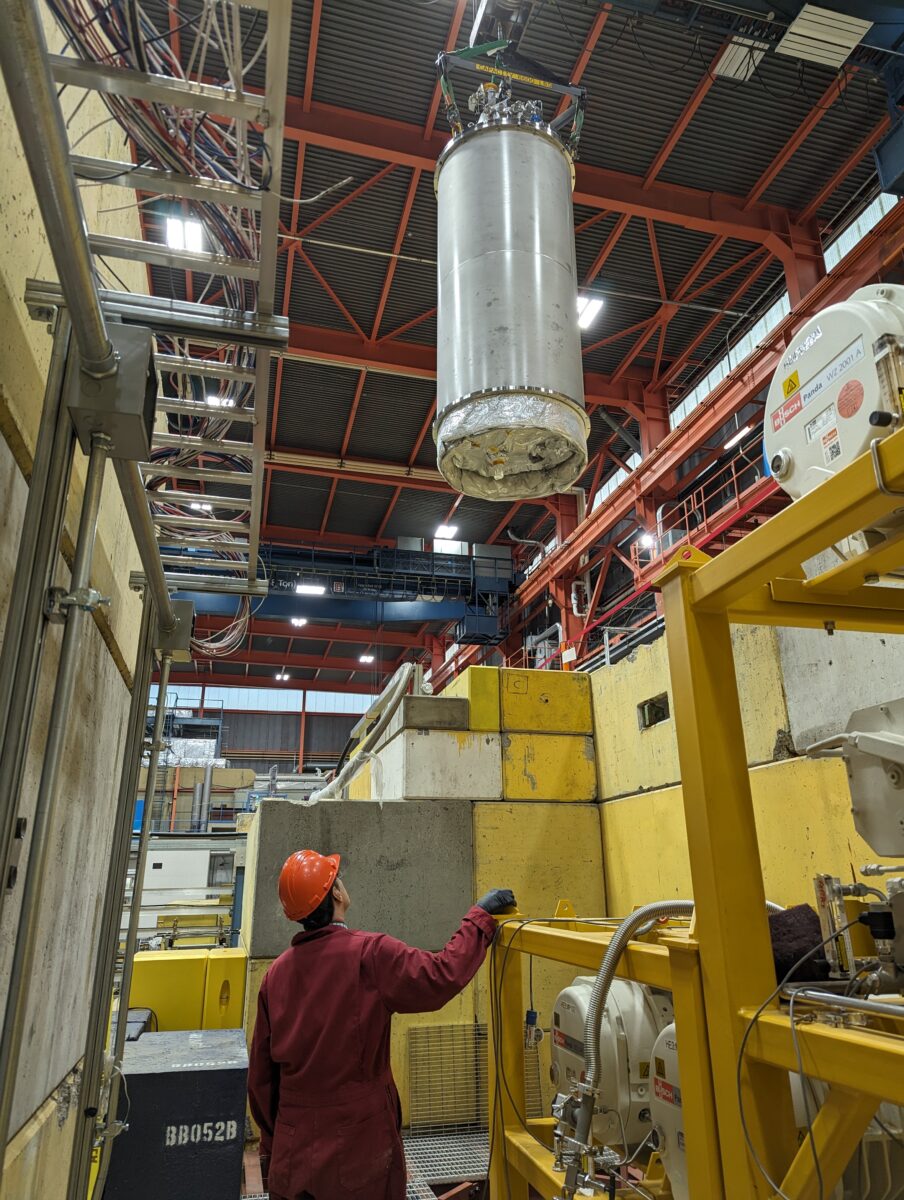 Jeffery Martin’s research at TRIUMF, the helium refrigerator from Japan is craned into place in the ultracold neutron source area. Jeffery Martin’s research at TRIUMF, the helium refrigerator from Japan is craned into place in the ultracold neutron source area. |
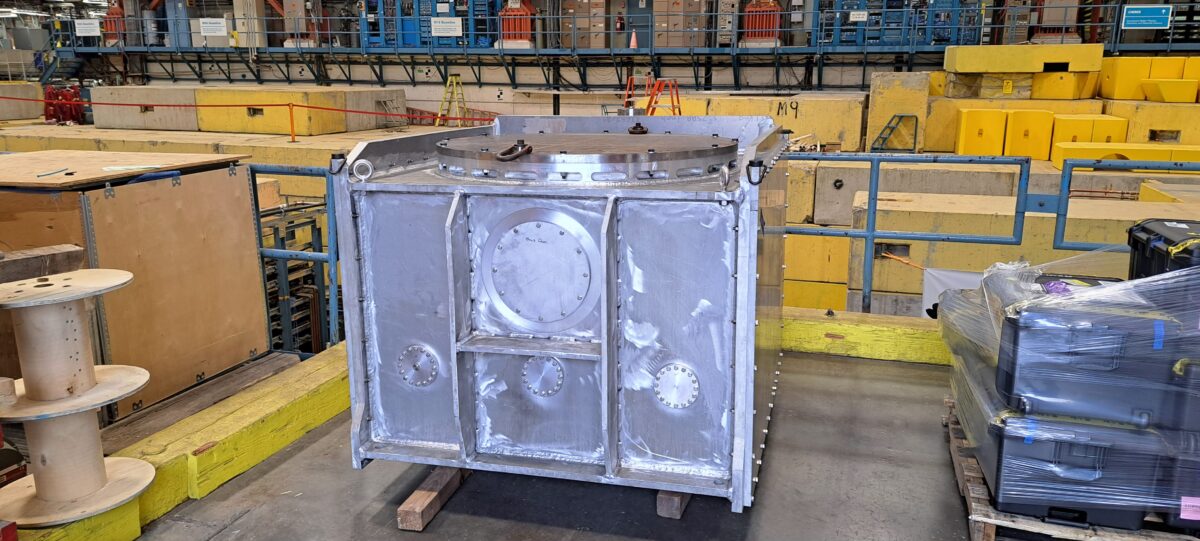 The cryo-connection box, the central unit which connects all parts of the ultracold neutron source. The helium refrigerator in the previous picture is craned in to rest on top of the box. The cryo-connection box, the central unit which connects all parts of the ultracold neutron source. The helium refrigerator in the previous picture is craned in to rest on top of the box. |
Planetary Science & Exploration
This research focuses on understanding the surfaces, geology, and history of objects such as Mars and Earth’s moon. The work supports space missions by helping scientists identify signs of water, geological processes, and possible past life beyond Earth.
| Program | Researcher | Project Title | Lay Summary |
| 2022 Master’s Studentship Award | Nathalie Turenne (University of Winnipeg Faculty of Graduate Studies) | Spectroscopy of modern low-temperature Mg-carbonate precipitates near Atlin, British Columbia, Canada: Relevance to Jezero crater, Mars | Studies Earth rocks similar to Mars to help identify chemical signs of ancient water and possible life. |
| 2024 CFI Matching Funds Program | Edward Cloutis (University of Winnipeg) | Planetary Surface Exploration Using Multispectral Imagery | Uses spacecraft-style cameras on Earth and labs to study the Moon and Mars and search for signs of past life. |
Satellite & Space‑Based Earth Observation
This includes projects that use satellites or satellite‑supported tools to observe Earth’s land, water, ice, climate, and ecosystems. These technologies help governments, communities, and industries monitor environmental change, manage resources, and respond to natural risks more effectively.
| Program | Researcher | Project Title | Lay Summary |
| 2023 Master’s Studentship Award | Ayomide Fatogun (University of Winnipeg Faculty of Graduate Studies) | Aerial Surveys of Moose using Drone and Satellite Imagery in Manitoba | Uses satellite images and drones with AI to safely and cheaply count wildlife without risky helicopter flights. |
| 2020 CFI Matching Funds | Dustin Isleifson (University of Manitoba) | An L-band Radar Remote Sensing System for Arctic Applications | Builds advanced L-band radar systems that complement satellite observations to monitor Arctic sea ice, improve ice prediction models, and support safer shipping and oil spill response. The system is deployable at facilities such as the Churchill Marine Observatory and provides data used by researchers, industry, and policymakers to better understand climate-driven changes in Canada’s North. |
| 2021 New Investigator Operating Grant | Karen Alley (University of Manitoba) | Using Remote Sensing to Determine the Drivers of Change on Sydkap Glacier, Southern Ellesmere Island | Uses satellite data to track glacier thinning and improve sea-level rise predictions. |
| 2025 New Investigator Operating Grant | Donghoon Lee (University of Manitoba) | Advancing Manitoba’s Hydropower Resilience and Water Management by Integrating SWOT Observations and Climate Forecasting | Uses NASA satellite water data and climate forecasts to improve hydropower reliability. |
 A photo of Sydkap Glacier, where Karen Alley’s research was conducted using satellite data.
Space Communications & Non‑Terrestrial Networks
These projects develop communication technologies that connect satellites, aircraft, and ground‑based networks into a single system. These systems enable reliable internet and data services in remote areas, during emergencies, and for future global connectivity through space‑based infrastructure.
| Program | Researcher | Project Title | Lay Summary |
| 2025 New Investigator Operating Grant | Peng Hu (University of Manitoba) | Digital Twin-Based Resilient LEO Satellite Networks and Systems | Applies AI digital twins to detect and fix problems in low-Earth-orbit satellite internet systems. |
| 2025 CFI Matching Funds Program | Peng Hu (University of Manitoba) | Infrastructure to Advance the Study of Space-Air-Ground Integrated Network Systems and Applications | Creates a lab to study how satellites, aircraft, and ground networks work together for global connectivity. |
| 2024 PhD Research Studentship Award | Volodymyr shyianov (University of Manitoba Faculty of Engineering) | Towards a sustainable and multi-functional wireless infrastructure – wideband transceivers design and proof of concept | Designs advanced radio hardware for future 6G networks including satellite-based systems. |
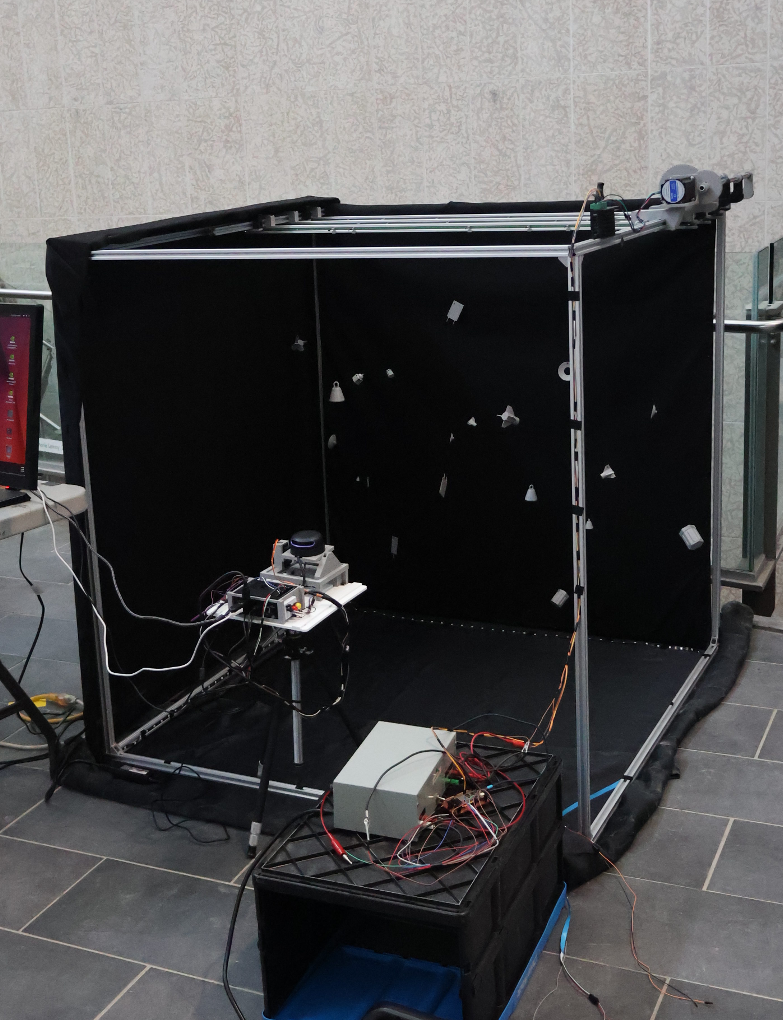
From Peng Hu’s research, a photo of a testbed built for space object detection from his Advanced Network and Embedded Systems Lab (AEL).
Space‑Enabling Instrumentation & Detectors
These projects develop advanced sensors, detectors, and research infrastructure that enable scientists to observe and understand the universe. While built on Earth, these technologies are essential for space-based and space-related experiments that study cosmic particles, astrophysical phenomena, and the fundamental forces shaping the universe.
| Program | Researcher | Project Title | Lay Summary |
| 2020 CFI Innovation Fund Matching Funds | Blair Jamieson (University of Winnipeg) | Intermediate Detector for the Hyper-Kamiokande Neutrino Oscillation Experiment | Designs advanced neutrino detectors that support global experiments studying particles produced in cosmic processes, helping scientists better understand how the universe evolves. |
| 2024 CFI Matching Funds Program | Russell Mammei (University of Winnipeg) | Thin Film Coatings for Fundamental Physics with Ultracold Neutrons | Develops specialized coatings that improve experiments on neutrons, helping scientists better understand how the universe works and what happens in extreme space environments like neutron stars. |
| 2025 CFI Matching Funds Program | Savino Longo (University of Manitoba) | Subatomic Particle Detector Innovation Laboratory | Establishes a laboratory to develop next-generation detectors used in international experiments that investigate cosmic particles and the structure of the universe. |
| 2021 CFI Matching Funds Program | Wouter Deconinck (University of Manitoba) | Subatomic Physics Detector Development Infrastructure | Provides specialized tools to design precision detectors that contribute to global research on fundamental particles and the forces that shape astrophysical phenomena |
Mitacs and Manitoba space research
“Manitoba is one of Canada’s shining stars in aerospace and space innovation, home to world-class researchers and industry partners advancing everything from lunar exploration to next-generation spacecraft components. Over the past five years, Mitacs has invested more than $1 million alongside aerospace partners in Manitoba, deploying student talent to help turn bold ideas into real-world impact. Through our partnership with Research Manitoba, we are proud to help build a stronger, more resilient Canadian economy powered by ideas, talent, and innovation.”
In addition to these projects, Research Manitoba provides funding to Mitacs, which supports local talent in space exploration through student internships and research partnerships that connect universities with industry and space-sector collaborators. These placements enable students to contribute directly to active projects while gaining practical experience in scientific analysis and engineering development.
One placement is at the University of Winnipeg’s Centre for Terrestrial and Planetary Exploration, where Philip Ferguson (who works for STARlab at University of Manitoba) is working alongside Ed Cloutis on technologies for lunar exploration, including rover components and sample-handling systems. Their work brings together planetary science and satellite engineering. Cloutis focuses on analyzing minerals and planetary surfaces using spectroscopy to better understand bodies such as Mars and asteroids, while Ferguson specializes in the design and development of small satellites.
Together, their collaboration, including initiatives such as ManitobaSat-1, examines how materials change in space and advances the tools needed to collect and interpret that data. This work supports future space missions and strengthens Canada’s space research capacity. It also includes the development of 3D-printed devices designed to operate in space environments, in collaboration with industry partners such as Magellan Aerospace. An experimental payload carrying geological samples has already been launched into orbit as part of a test mission, demonstrating Manitoba’s growing role in hands-on space technology development.
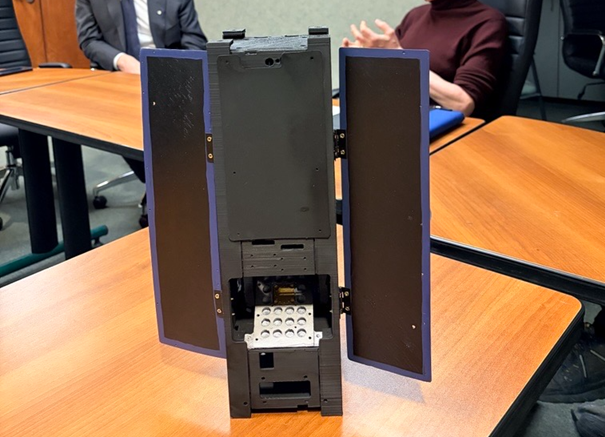
An image of the Iris CubeSat (or Manitoba Sat-1) which was launched to the International Space Station in June 2023 and deployed into low-Earth orbit shortly after to study space weathering.
Student researchers and postdoctoral fellows supported through programs such as Mitacs play a key role in this work, underscoring the importance of training and talent development in sustaining Manitoba’s presence in the space sector.
Manitoba-based space projects that Mitacs has supported include:
| Institution(s) | Professor | Sponsor | Title |
| University of Manitoba | Matt Khoshdarregi | Magellan Aerospace Corp | Vison-based frameworks for automated robotic machining of aerospace composite panels |
| University of Manitoba | Philip Ferguson | Volatus Aerospace | Aerial and Ground-based Robotic Litter Mitigation System for Sensitive Ecosystems |
| University of Manitoba / Red River College Polytechnic | Jolen Galaugher; Janfizza Bukhari | North Forge | TRLUP – Conceptual study of next-generation spacecraft components |
| University of Winnipeg | Edward Cloutis | Mission Control | Searching for In-Situ Resources on the Moon |
| University of Winnipeg | Edward Cloutis | Planet Labs Geomatics Corp | Developing robust surface reflectance retrievals for Planet’s hyperspectralsatellite Tanager-1 |
| University of Winnipeg | Edward Cloutis | MPB Communications (Pointe-Claire, QC) | Exploring the Moon with Canada’s Volatiles Moon Mineralogy Orbiter |
| University of Winnipeg | Edward Cloutis | Canadensys Aerospace | Canada’s First Planetary Mission: The Canadian Lunar Rover Mission |
Other Manitoba space research
Often, initial Research Manitoba funding earlier in their careers enabled researcher to reach the level of success needed to qualify for large national and international grants.
Here is further information on their projects that have received substantial recognition:
Evan McDonough who received a New Investigator Operating Grant in 2023, credits Research Manitoba’s grant as vital for later receiving an Arthur B. McDonald Canadian Astroparticle Physics Research Institute grant to study astrophysics and the origin of the matter-antimatter asymmetry of the universe. Prior to his Research Manitoba grant, he had received an NSERC Discovery Grant for “Dark Matter in Extreme Environments”. He is also a member of the CASTOR telescope collaboration as part of the cosmology working group. For more information: https://www.uwinnipeg.ca/physics/people/evan-mcdonough.html
Raghavan Jayaraman (received a 2017 Research Manitoba grant). Raghavan’s work focuses on polymer and composite materials for advanced manufacturing and aerospace applications. Since 2017, his research has explored sustainable and high-performance composites, including natural-fibre materials derived from agricultural waste and recycled polymers, as well as multifunctional structures for use in systems like satellites.
He has also contributed to industry-driven aerospace innovation through collaborations with partners such as Magellan Aerospace. Notably, he was a member of the composites working group in Manitoba’s Aerospace Technology Roadmap, helping guide research priorities alongside industry leaders. His work has included projects supported by Magellan and the Canadian Space Agency, such as the development of lightweight multifunctional composite structures for space applications, as well as applied research partnerships aimed at advancing manufacturing and commercialization in Manitoba’s aerospace sector.
Samar Safi-Harb and Tyrone Woods both recently received a 2026 CFI/Research Manitoba Innovation Fund Award for gravitational wave astronomy.
Samar Safi-Harb is a Canada Research Chair Tier 1 in astrophysics at the University of Manitoba, recognized internationally for her work on high-energy astrophysics. Her research focuses on supernova remnants, neutron stars, and pulsar wind nebulae, using data from major observatories such as Chandra X-ray Observatory and XMM-Newton to better understand how stars explode and evolve. She has led or contributed to numerous high-impact studies that advance knowledge of the life cycle of matter in the universe.
She is the lead in the following groups at the University of Manitoba:
- LIGO Scientific Collaboration: Participation in this international partnership underpins a co-investigator role on the GRAIN project, funded by the Canada Foundation for Innovation and Research Manitoba, supporting research into extreme astrophysical phenomena through gravitational wave science.
- Advanced X-ray Imaging Satellite (AXIS): Involvement in this proposed NASA-led X-ray mission for the 2030s contributes to efforts to study high-energy processes in deep space, including black holes and the evolution of galaxies.
Recent achievements by her group include discovering the true scale of a nearby supernova.
More information on her work can be found at:
Official Website;
Faculty Website
Tyrone Woods is an astrophysicist at the University of Manitoba and serves as co-principal investigator for the CASTOR space telescope, a proposed Canadian-led space mission designed to observe the universe in ultraviolet wavelengths. His research focuses on stellar evolution, particularly how massive stars lose mass and interact with their environments over time. Through his leadership on CASTOR, he is helping position Canada at the forefront of next-generation space astronomy, with the mission expected to enable breakthroughs in areas such as galaxy formation, dark matter, and the interstellar medium.
More information on his work can be found here: Tyrone Woods – Physics and Astronomy profiles | Faculty of Science | University of Manitoba
As international interest in space continues to grow, Manitoba’s integrated approach – combining scientific discovery, applied engineering, and talent development – positions us as a quiet but essential force in Canada’s expanding space ambitions.
Contact:
Communications, Research Manitoba
info@researchmb.ca | researchmanitoba.ca
Research Manitoba
Research Manitoba promotes, supports, and coordinates the funding of research excellence and innovation in health, natural and social sciences, engineering, and the humanities in Manitoba. Research Manitoba supports local talent development by providing research support to early career researchers and graduate students, along with fostering strategic partnerships to strengthen research and innovation in Manitoba.