

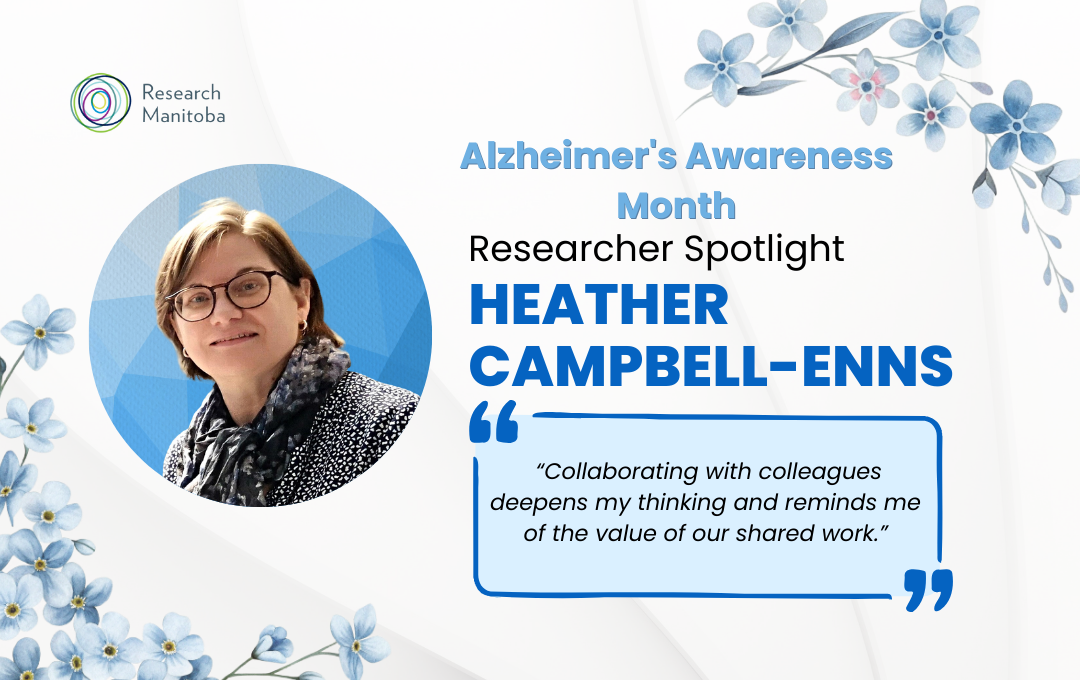
About our image: The forget-me-not was first adopted as a dementia symbol by European Alzheimer advocacy groups, firstly from German Alzheimer Association in the 1990s, where the blue forget-me-not was used to represent memory and solidarity with people living with dementia. This symbol later gained broader international recognition through the Alzheimer’s Society in the United Kingdom, which formally launched the ‘Forget Me Not’ appeal in 2013, helping establish the flower as a widely recognized global symbol of Alzheimer’s awareness. Today, the flower is a symbol of many Alzheimer awareness groups across the world.
January 12, 2026 – Winnipeg, MB
January marks Alzheimer Awareness Month in Canada, a time to recognize the more than 600,000 people across the country living with Alzheimer’s disease and other dementias, and the many families, caregivers, clinicians, and researchers working to support them. Here in Manitoba, over 20,300 residents currently have a dementia disease, and over 62% of Manitobans have a friend or family member who struggle with dementia.
In January, Research Manitoba highlights local research that helps to improve prevention, care, and quality of life for people affected by dementia.
This year’s spotlight is on Dr. Heather Campbell-Enns, a Manitoba researcher whose career reflects deep commitment to families, caregiving, and aging across our province and blends scientific research with true empathy and a passion for creating change. Research Manitoba is proud to have supported Dr. Campbell-Enns throughout her professional journey, from her first PhD Studentship, to her New Investigator Operating Grant, to her most recent Alzheimer Society Research Program award. We have also been honoured to have Dr. Campbell-Enns volunteer as a peer reviewer for our grant programs, as she gives back to the system that supported her work.
Dr. Campbell-Enns is an Associate Professor of Psychology at Canadian Mennonite University, where she holds a Tier 2 Canada Research Chair in Families and Aging. Her research path began with a focus on how families navigate complex health decisions. Her Master’s work examined motherhood and decision making in the context of cancer, followed by her PhD project, “Exploring the Decision-Making Process of Young Parents with Cancer,” supported through a Manitoba Health Research Council (now Research Manitoba) PhD Studentship. These early experiences laid the foundation for a program of research grounded in empathy, relationship, and the real-life challenges families face.
After eight years of oncology-focused research, Dr. Campbell-Enns accepted a postdoctoral fellowship outside of oncology, where she began to focus on older adults in both community and long-term care settings.
“At the time, this felt more like an expansion of my learning than a shift in focus, since I did not plan to move away from oncology long-term. However, through this work I began to hear family stories about dementia and to see the significant need for research in this area. The skills I developed in oncology research, particularly through my work at CancerCare Manitoba, translated directly into my current dementia-focused research.”
Over time, Dr. Campbell-Enns’ focus shifted toward aging and dementia, particularly how intergenerational families care for loved ones living with dementia. In 2019, Dr. Campbell-Enns further expanded her learning as a new investigator after receiving a Research Manitoba New Investigator Operating Grant for “A Comparative Analysis of Manitoba Rural and Urban Hospital Discharge Policies for Persons with Dementia”.
Most recently, in 2025, she received a New Investigator Grant through the national Alzheimer Society Research Program, co-funded by Research Manitoba, for “A Pilot Study of Ethnocultural Approaches to Family-Provided Dementia Care.” This project examines how cultural traditions, immigration experiences, and family dynamics shape caregiving for people with dementia, with the goal of improving culturally responsive supports.
Reflecting on her career and the role of provincial investment for research, Dr. Campbell-Enns notes,
“Receiving Research Manitoba investments through the PhD Studentship, New Investigator Operating Grant, and now partnering with ASRP funds to launch a key study in my Canada Research Chair program has been crucial to my research trajectory.”
In addition to her research, Dr. Campbell-Enns contributes generously to the broader academic community. She has participated as a peer reviewer for Research Manitoba’s Studentship Awards, supporting emerging researchers who are now at the beginning of their own journeys. As she explains,
“Participating as a peer reviewer offers a valuable opportunity to contribute to the research community through detailed, constructive feedback to applicants and engagement with peers who bring diverse perspectives. Reviewing high-quality ideas and proposals is an energizing experience.”
Her work has also been nationally recognized through Canadian Institutes of Health Research support. During a CIHR Health Systems Impact Fellowship, Dr. Campbell-Enns partnered with Manitoba Health to help translate evidence into policies that better support older adults, including approaches that help people remain in their homes and communities rather than moving into institutional care.
“I gravitate toward research examining intergenerational care within families, particularly the “upward” transfer of care between adult children and their parents. With this, I am interested in research exploring theoretical explanations for which family members take on caregiving responsibilities, and why.”
Dr. Campbell-Enns has also collaborated on CIHR-supported studies that examine how people with dementia transition from hospital back into their communities and how systems can better support families during these critical moments. Her Canada Research Chair further strengthens this work, allowing her to explore how families across cultures navigate caregiving, resilience, and aging, and how health systems can respond more thoughtfully.
Dr. Campbell-Enns feels strongly about the value of collaboration in her work:
“Locally, my closest collaborators are research affiliates at the Centre on Aging at the University of Manitoba. The colleague I have worked with most closely over the years, across both oncology and aging research, is Dr. Genevieve Thompson in the College of Nursing. We recently completed a systematic review on the needs of adult siblings caring for a parent living with dementia, and her expertise in long-term care brings a valuable perspective that complements my own. Collaborating with colleagues deepens my thinking and reminds me of the value of our shared work.”
Through these initiatives, training opportunities, and community partnerships, Dr. Campbell-Enns’ work helps bridge research, policy, and everyday caregiving experiences. Her career shows how early work in cancer-related decision making has grown into an internationally recognized program focused on dementia, caregiving, and aging, improving quality of life for people living with Alzheimer’s disease and other dementias.
It has been such a privilege to work with Heather since her time at CancerCare Manitoba. I have witnessed her passion for improving the care of those impacted by cancer and now for those living with and caring for people with dementia. It requires a special kind of individual to bear witness and do justice to stories that can involve polar extremes of emotions and experiences; from deep feelings of grief and loss, to joy and fulfilment. Heather is that person.
Related links:
- Dementia by the numbers – Alzheimer’s Society of Manitoba
- CMU psychology professor awarded grant for dementia research | News and Releases | CMU
- Heather Campbell-Enns | Faculty and Staff | CMU
- Caring across cultures: Manitoba researcher wins funding – Alzheimer’s Society of Manitoba
- Canada Research Chair – Heather Campbell-Enns
- Heather Campbell-Enns – Health System Impact Fellow Profile – CIHR
Contact:
Hope Holmes, Communications Officer, Research Manitoba
E: info@researchmb.ca | W: researchmanitoba.ca
Research Manitoba promotes, supports, and coordinates the funding of research excellence and innovation in health, natural and social sciences, engineering, and the humanities in Manitoba. Research Manitoba supports local talent development by providing research support to early career researchers and graduate students, along with fostering partnerships to strengthen research innovation in Manitoba.